Wednesday, November 4, 2009
Status of Independent EMBs
An interesting question arose in my mind at a recent training in Brussels. International agencies that sign technical assistance agreements with EMBs, strive to gain an invitation from these EMBs. These agreements are separate (though may be the same) as may be signed with the host government. Does this agreement with the EMB elevate the institution to another sphere of governance, similar to the Executive, Legislature or Judiciary? Although these agreements may serve simply to have a formal endorsement from the inviting EMB, it does raise the question of the exact status of independent EMBs. Are we creating separate governance structures through these actions. What do you think?


Saturday, June 6, 2009
Changes to BRIDGE Facilitation Categories

BRIDGE, the world's foremost elections curriculum, has undergone some changes. For one, it is no more known as BRIDGE Project, but simply as BRIDGE. Other changes are more fundamental than this. At the last meeting of the BRIDGE Partners (UNEAD, IDEA, IFES, UNDP and AEC)in November 2008 in Sydney, it was decided to streamline the facilitator categories. No longer is there a reference to Level 1 to 5 for facilitators, but the names are more reflective of the reality on the ground. One major change is that the person who accredits a facilitator is called an Accrediting Facilitator. This person is no longer the highest rank of facilitator that you can find. Clearer guidelines on the facilitator structure has emerged. The picture above spells it out more clearly. Distribute it to fellow BRIDGE Facilitators. Spread the word.
Tuesday, January 6, 2009
The Predatory State: Is this the future?
Larry Diamond analyses an interesting phenomenon he calls the predatory state, which is emerging in the modern day. In his article, he emphasises some important challenges democracies face. Do you agree with his analysis? What role do you play in improving governance and the upholding of citizen's rights and access to structures of governance?
The article can be found at here.
The article can be found at here.
Sunday, January 4, 2009
Look back and walking forward
Its been a busy year. Including doing work in South Africa, I've been in 12 countries this year (Jordan twice) conducting trainings and attending meetings. Amazing experiences I had this year involve:
• Watching the Zimbabwean dollar in free-fall and people making a living despite this.
• Building great friendships during a BRIDGE Train-the-Facilitator workshops in South Africa.
• Meeting Dr Afari-Gyan, one of the great elders of African elections, in Ghana.
• Preparing a nerve-wrecking BRIDGE course in Botswana (all preparations were done in 2.5 days flat! Please let's not do that again!).
• Visiting Petra, Wadi Rum and dancing on a boat on the Red Sea in Jordan (first visit).
• Enlightening statisticians on elections and democracy assessment in Namibia.
• Seeing the Door of No Return on Goree Island and meeting Breyten Breytenbach in Dakar.
• Freezing in the highlands of Lesotho (no central heating!).
• Visiting the Pyramids of Giza and floating on the Nile in Cairo.
• Floating (without a boat this time) on the Dead Sea in Jordan (my second visit) whilst engaging in strategic planning with local election professionals.
• Linking with some of the most passionate minds on elections capacity development from around the world in idyllic Sydney.
• Coming down to earth in the dusty boom-town of Juba in South Sudan working with the UNDP and UNMIS and of course seeing the Nile from another point further south.
• Meeting awesome people from around the world and thrilling in how more people are starting to take elections training seriously world-wide.
Of course there were some setbacks on my part, but these fade in comparison to the wealth of experiences. My gratitude goes to all those who contributed to a wonderful year.
On the elections front, Kenya, Zimbabwe and Nigeria reminded us all of the fragility of elections on the continent. Kenya had successful power-sharing talks, whilst in Zimbabwe it has failed. Ghana, with its two-round system of presidential elections, is restoring some faith in elections as a peaceful means of democratic transition in Africa. Taiwan, Russia, Pakistan, Ireland, Canada and Georgia had new presidents or prime ministers elected/appointed or existing ones reconfirmed. Kosovo declared independence and Georgia was invaded by Russia. Nepal held historic first elections, whilst the Bolivian president survived a recall-referendum. Ukraine saw their parliament dissolved and coup d'etats were carried out in Mauritania and Guinea. We saw the US elect its first black president in a campaign that had the entire world glued to their televisions for months. On other related fronts,we saw the free market system get a reality check that could see some important shifts in economic practices around global financial systems. Terror attacks saw many die in India, Pakistan, and other countries in the world, grim reminders of the destabilised world, where basic freedoms are limited through violent means.
To top off 2008 I was invited to take on a portfolio with International IDEA on capacity development and participation. As of 1 Dec 2008 I ceased working as an independent consultant and joined IDEA, working out of their Africa and Middle East Office in Pretoria, but reporting to Stockholm (Sweden), working on global projects under Ross Attrill, who is standing in for Paul Guerin (away on paternity leave). As I head for Stockholm later this month I am keen to hear from all of you what are burning issues that require tackling in my new portfolio. Capacity development will obviously involve BRIDGE, but also other areas such as e-learning and leadership development amongst EMBs. The participation area will obviously focus on citizen participation in democracies, focussing strongly on elections but extending far further than voter turnout. Let me know what you see as challenges and how they could be addressed.
In 2009 16 elections are sheduled for Africa alone, of which the biggest and most important must be the Sudanese presidential elections. South Africa has its own political intrigues that should see increased voter interest at the polls, but potentially may result in many campaign headaches for the South African EMB. With these kinds of developments, the elections front will continue to keep all of us on our toes.
Best wishes to all of you out there for 2009 and remember to drink (safe) water! If you are running an election or observing one of the many this year, you need to be at your peak performance. Water forms 75% of your body and just a 2% drop marks mild dehydration, causing fuzzy short-term memory, trouble with basic math, and difficulty focusing on smaller print, such as a computer screen. But dont take my word for it, educate yourself! And remember to Drink Up! Enjoy the thing that makes our planet special...
Make 2009 a positive year to remember!
• Watching the Zimbabwean dollar in free-fall and people making a living despite this.
• Building great friendships during a BRIDGE Train-the-Facilitator workshops in South Africa.
• Meeting Dr Afari-Gyan, one of the great elders of African elections, in Ghana.
• Preparing a nerve-wrecking BRIDGE course in Botswana (all preparations were done in 2.5 days flat! Please let's not do that again!).
• Visiting Petra, Wadi Rum and dancing on a boat on the Red Sea in Jordan (first visit).
• Enlightening statisticians on elections and democracy assessment in Namibia.
• Seeing the Door of No Return on Goree Island and meeting Breyten Breytenbach in Dakar.
• Freezing in the highlands of Lesotho (no central heating!).
• Visiting the Pyramids of Giza and floating on the Nile in Cairo.
• Floating (without a boat this time) on the Dead Sea in Jordan (my second visit) whilst engaging in strategic planning with local election professionals.
• Linking with some of the most passionate minds on elections capacity development from around the world in idyllic Sydney.
• Coming down to earth in the dusty boom-town of Juba in South Sudan working with the UNDP and UNMIS and of course seeing the Nile from another point further south.
• Meeting awesome people from around the world and thrilling in how more people are starting to take elections training seriously world-wide.
Of course there were some setbacks on my part, but these fade in comparison to the wealth of experiences. My gratitude goes to all those who contributed to a wonderful year.
On the elections front, Kenya, Zimbabwe and Nigeria reminded us all of the fragility of elections on the continent. Kenya had successful power-sharing talks, whilst in Zimbabwe it has failed. Ghana, with its two-round system of presidential elections, is restoring some faith in elections as a peaceful means of democratic transition in Africa. Taiwan, Russia, Pakistan, Ireland, Canada and Georgia had new presidents or prime ministers elected/appointed or existing ones reconfirmed. Kosovo declared independence and Georgia was invaded by Russia. Nepal held historic first elections, whilst the Bolivian president survived a recall-referendum. Ukraine saw their parliament dissolved and coup d'etats were carried out in Mauritania and Guinea. We saw the US elect its first black president in a campaign that had the entire world glued to their televisions for months. On other related fronts,we saw the free market system get a reality check that could see some important shifts in economic practices around global financial systems. Terror attacks saw many die in India, Pakistan, and other countries in the world, grim reminders of the destabilised world, where basic freedoms are limited through violent means.
To top off 2008 I was invited to take on a portfolio with International IDEA on capacity development and participation. As of 1 Dec 2008 I ceased working as an independent consultant and joined IDEA, working out of their Africa and Middle East Office in Pretoria, but reporting to Stockholm (Sweden), working on global projects under Ross Attrill, who is standing in for Paul Guerin (away on paternity leave). As I head for Stockholm later this month I am keen to hear from all of you what are burning issues that require tackling in my new portfolio. Capacity development will obviously involve BRIDGE, but also other areas such as e-learning and leadership development amongst EMBs. The participation area will obviously focus on citizen participation in democracies, focussing strongly on elections but extending far further than voter turnout. Let me know what you see as challenges and how they could be addressed.
In 2009 16 elections are sheduled for Africa alone, of which the biggest and most important must be the Sudanese presidential elections. South Africa has its own political intrigues that should see increased voter interest at the polls, but potentially may result in many campaign headaches for the South African EMB. With these kinds of developments, the elections front will continue to keep all of us on our toes.
Best wishes to all of you out there for 2009 and remember to drink (safe) water! If you are running an election or observing one of the many this year, you need to be at your peak performance. Water forms 75% of your body and just a 2% drop marks mild dehydration, causing fuzzy short-term memory, trouble with basic math, and difficulty focusing on smaller print, such as a computer screen. But dont take my word for it, educate yourself! And remember to Drink Up! Enjoy the thing that makes our planet special...
Make 2009 a positive year to remember!
Tuesday, October 14, 2008
Strategic Planning at the Lowest Point on Earth

From the 6th to 9th October, election practitioners from the Jordanian Ministry of the Interior engaged in strategic planning at the Marriot’s Jordan Valley Hotel Dead Sea Resort and Spa. Two 2-day sessions were run with 22 participants in each session. The event was organized by IFES and comes after a number of other BRIDGE activities that have been run in the country. Heads of electoral districts came from across the country to attend the strategic planning training.
The participants are responsible for the management of elections in their electoral districts and do this on a part-time or temporary basis, balancing this work with their other responsibilities for the Ministry of the Interior. Coming from 42 electoral districts (excluding the 3 Bedouin districts) across 11 governorates, the participants are the highest ranking election practitioners outside of head office.
The BRIDGE course depended heavily on the strategic planning for EMBs document that was compiled by Joe Baxter from IFES several years ago. This document was translated into Arabic for this course. Participants were also provided with the IDEA Handbook on Election Management Body Design, also in Arabic. The course was run by myself and Hermann Thiel, assisted by Sara Al-Utaibi (IFES) and Sa’ad Al Shehab (Ministry of Interior). During the workshop, Sa’ad Al Shehab received his full accreditation as a BRIDGE facilitator and becomes the first representative from the Ministry to achieve the status. This step is an important step in the growth of BRIDGE in Jordan, increasing the prospect of future independent offerings of BRIDGE within the Ministry.
Participants received the training enthusiastically as this marks the first such a focus on broader strategic planning regarding elections within the Ministry. Some of the participants will go on to become governors within the different areas and this investment in their understanding of elections and planning will reap benefits in future. This session, focusing on key concepts and tools for strategic planning, is hoped to form the basis for a future follow-up which will review the 2007 elections and craft a proper strategic plan for the 2011 elections.
Tuesday, August 19, 2008
Running a BRIDGE course
So you want to run a BRIDGE course?  BRIDGE has grown into the de facto elections training curriculum around the world today. Short for Building Resources in Democracy, Governance and Elections, the course has developed out of initiatives by the Australian Electoral Commission, International IDEA and the UN's Electoral Assistance Division. A testimony to its growth is the addition in recent years of IFES and UNDP as partners in the BRIDGE Project.
With capacity development in elections becoming a major focus in many countries, BRIDGE represents a short-cut (not replacement) to the many years of on-the-job learning many of us were exposed to when we started in elections. However, many who see it as a simple "entry-level" training miss the point completely. Whilst it can serve that purpose, it also can act as a wake-up learning programme for those officials that have clocked up 10 to 20 years of experience behind them in the elections field. Many of these veterans have not been exposed to elections outside of their own contexts and have become complacent in what they know and tied to the belief that theirs is the best way of tackling their specialist areas.
So... Is BRIDGE the panacea for all election training ills? Well, with 23 modules covering the whole range of elections practices within the election cycle, it most certainly comes across as just what the doctor ordered. The 23 modules are structured around foundation modules, electoral architecture, stakeholders and operations. With massive flexibility coming through customisation options, one seems to be able to craft almost any training on elections around it. But, this flexibility and myriad of modules also becomes BRIDGE's greatest weakness. While in theory any accredited facilitator can appear to tackle the training, the reality and practice are quite the opposite.
A few key things spring to mind when considering selecting a credible facilitator:
Define "Why" Clearly?
Understand that training is about change, whether it is about improving service delivery, introducing new technology changes or simply preparing people to do their jobs. You have identified a need for training/learning and it must be driven by understanding of why. Be clear about what the change is that you wish to see. Maybe it is about addressing past problems or pushed by a need for reform or wanting to introduce a new culture of learning? Be clear about why you want the training.
Understand the Target Group
You need to understand your audience. Understanding who the audience is will guide you into your project proposal. Who are you doing the training for? What is their level of seniority? How many of them are there? What level of experience in elections do they have? What have their previous training experiences been? How does this audience fit into the broader scheme of capacity development or change that your are wanting to introduce? How long do you have for the training?
Maybe you need to separate the "audience" in two or more categories. Mixing executive management with operational or field staff might not work well. Each audience category has specific needs. Field staff need to know the detail of specific election procedures and the basic rationale behind the procedures. Executive management's focus may be more on the principles of elections and working with stakeholders. These needs can often be broken down into personal motivations, institutional/group areas and operational components. Once you can pin-point these needs, a more sophisticated picture can be developed on how training can be rolled out. Remember, people are not robots that follow recipes well. Problems in the field will quickly show up weaknesses in training that focuses simply on "robotic training".
Then what?
BRIDGE consists of 23 modules. What are the topic areas that are relevant to you? What problem areas are you trying to address? The module titled Introduction to Election Administration covers aspects of almost all the other modules. This is often a good place to start if you are not sure which modules to focus on. This module can then serve as the basis for other additions, such as greater focus on registration, contestants (political parties and candidates) or media. These components can then be added.
How long does it all take?
A typical one-week long course takes can take up to two years to put together! Rubbish is what I hear you say :-) That is if you don't have buy-in from key role-players. Have you got the funding to go ahead with the project? Have the key decision-makers inside the relevant institutions given the "green light" for the project? Does the timing of the project clash with operational time-lines? If you underestimate the amount of motivation and education that you need to put into the initial phases to get approval, then two years suddenly doesn't sound unrealistic.
However, once you have all your ducks in a row, then the next step is finding an available good facilitator, a suitable venue and making sure all the other administrative processes kick in. You may have to be prepared to wait up to two months for someone to be available. Thinking that you can also do the course with only one facilitator is unwise. The BRIDGE course prides itself on its participatory learning and drawing on global experiences. You will need at least two good fully accredited facilitators to run a full programme that lasts one week. Look for opportunities to fully accredit existing facilitators from the country or neighbouring countries.
A good venue for up to 25 participants needs to be roughly 22m x 11m. This allows for sufficient space for the various activities associated with a BRIDGE course, including ice-breakers, energizers, role plays, etc. Of course it is possible to run the sessions in smaller venues. Just make sure there is enough space elsewhere for some aspects of the course, like a large area outside the venue. The venue, along with translation services (if required), will require booking well beforehand, sometimes up to a month or two beforehand. Venues should of a suitable standard, being used regularly for similar or other conference-type events. The location of venues should also take into consideration the proximity to the head office of the participating institution, as inevitably participants' day-jobs will interfere with the course, regardless of how hard one tries to keep the learning separate. The disruptions to the course could simply prove to undermine the course to the extent of rendering its usefulness null and void.
I have a good lead facilitator and a venue...
Once facilitator/s and the venue is in place, a pre-course preparation is mandatory and this can be at least a week long prior to the course. Facilitators will need access to preparation space, printing and bulk copying/binding facilities in the run-up to the course. With a good lead facilitator the preparatory phase will be managed properly, ensuring that all the relevant materials are in place and to the appropriate standard, that all other facilitators have been briefed and are prepared for delivery of the course. The learning amongst experienced BRIDGE lead facilitators are such that checklists exist to cover most aspects of the logistical arrangements, from the preparatory phase through to the post-course component. What ultimately then distinguishes one from the other is style, experience and professionalism.
Then its all systems go...
For more information on how to go about organising your own BRIDGE course, contact me on nackerdienr@gmail.com.
BRIDGE has grown into the de facto elections training curriculum around the world today. Short for Building Resources in Democracy, Governance and Elections, the course has developed out of initiatives by the Australian Electoral Commission, International IDEA and the UN's Electoral Assistance Division. A testimony to its growth is the addition in recent years of IFES and UNDP as partners in the BRIDGE Project.With capacity development in elections becoming a major focus in many countries, BRIDGE represents a short-cut (not replacement) to the many years of on-the-job learning many of us were exposed to when we started in elections. However, many who see it as a simple "entry-level" training miss the point completely. Whilst it can serve that purpose, it also can act as a wake-up learning programme for those officials that have clocked up 10 to 20 years of experience behind them in the elections field. Many of these veterans have not been exposed to elections outside of their own contexts and have become complacent in what they know and tied to the belief that theirs is the best way of tackling their specialist areas.
So... Is BRIDGE the panacea for all election training ills? Well, with 23 modules covering the whole range of elections practices within the election cycle, it most certainly comes across as just what the doctor ordered. The 23 modules are structured around foundation modules, electoral architecture, stakeholders and operations. With massive flexibility coming through customisation options, one seems to be able to craft almost any training on elections around it. But, this flexibility and myriad of modules also becomes BRIDGE's greatest weakness. While in theory any accredited facilitator can appear to tackle the training, the reality and practice are quite the opposite.
A few key things spring to mind when considering selecting a credible facilitator:
- elections expertise (Has the person worked in the area? In what capacity?)
- facilitation competence (What experience as a facilitator does the person have?)
- inter-personal skills (Is there a personality "fit" between the person and yourself?)
- past experience/s in doing similar things (not necessarily BRIDGE, but also other training courses)
- knowledge of the materials (navigating through >5000 pages of material is no joke?)
Define "Why" Clearly?
Understand that training is about change, whether it is about improving service delivery, introducing new technology changes or simply preparing people to do their jobs. You have identified a need for training/learning and it must be driven by understanding of why. Be clear about what the change is that you wish to see. Maybe it is about addressing past problems or pushed by a need for reform or wanting to introduce a new culture of learning? Be clear about why you want the training.
Understand the Target Group
You need to understand your audience. Understanding who the audience is will guide you into your project proposal. Who are you doing the training for? What is their level of seniority? How many of them are there? What level of experience in elections do they have? What have their previous training experiences been? How does this audience fit into the broader scheme of capacity development or change that your are wanting to introduce? How long do you have for the training?
Maybe you need to separate the "audience" in two or more categories. Mixing executive management with operational or field staff might not work well. Each audience category has specific needs. Field staff need to know the detail of specific election procedures and the basic rationale behind the procedures. Executive management's focus may be more on the principles of elections and working with stakeholders. These needs can often be broken down into personal motivations, institutional/group areas and operational components. Once you can pin-point these needs, a more sophisticated picture can be developed on how training can be rolled out. Remember, people are not robots that follow recipes well. Problems in the field will quickly show up weaknesses in training that focuses simply on "robotic training".
Then what?
BRIDGE consists of 23 modules. What are the topic areas that are relevant to you? What problem areas are you trying to address? The module titled Introduction to Election Administration covers aspects of almost all the other modules. This is often a good place to start if you are not sure which modules to focus on. This module can then serve as the basis for other additions, such as greater focus on registration, contestants (political parties and candidates) or media. These components can then be added.
How long does it all take?
A typical one-week long course takes can take up to two years to put together! Rubbish is what I hear you say :-) That is if you don't have buy-in from key role-players. Have you got the funding to go ahead with the project? Have the key decision-makers inside the relevant institutions given the "green light" for the project? Does the timing of the project clash with operational time-lines? If you underestimate the amount of motivation and education that you need to put into the initial phases to get approval, then two years suddenly doesn't sound unrealistic.
However, once you have all your ducks in a row, then the next step is finding an available good facilitator, a suitable venue and making sure all the other administrative processes kick in. You may have to be prepared to wait up to two months for someone to be available. Thinking that you can also do the course with only one facilitator is unwise. The BRIDGE course prides itself on its participatory learning and drawing on global experiences. You will need at least two good fully accredited facilitators to run a full programme that lasts one week. Look for opportunities to fully accredit existing facilitators from the country or neighbouring countries.
A good venue for up to 25 participants needs to be roughly 22m x 11m. This allows for sufficient space for the various activities associated with a BRIDGE course, including ice-breakers, energizers, role plays, etc. Of course it is possible to run the sessions in smaller venues. Just make sure there is enough space elsewhere for some aspects of the course, like a large area outside the venue. The venue, along with translation services (if required), will require booking well beforehand, sometimes up to a month or two beforehand. Venues should of a suitable standard, being used regularly for similar or other conference-type events. The location of venues should also take into consideration the proximity to the head office of the participating institution, as inevitably participants' day-jobs will interfere with the course, regardless of how hard one tries to keep the learning separate. The disruptions to the course could simply prove to undermine the course to the extent of rendering its usefulness null and void.
I have a good lead facilitator and a venue...
Once facilitator/s and the venue is in place, a pre-course preparation is mandatory and this can be at least a week long prior to the course. Facilitators will need access to preparation space, printing and bulk copying/binding facilities in the run-up to the course. With a good lead facilitator the preparatory phase will be managed properly, ensuring that all the relevant materials are in place and to the appropriate standard, that all other facilitators have been briefed and are prepared for delivery of the course. The learning amongst experienced BRIDGE lead facilitators are such that checklists exist to cover most aspects of the logistical arrangements, from the preparatory phase through to the post-course component. What ultimately then distinguishes one from the other is style, experience and professionalism.
Then its all systems go...
For more information on how to go about organising your own BRIDGE course, contact me on nackerdienr@gmail.com.
Thursday, June 26, 2008
Quo Vadis Zimbabwe?
"It is not power that corrupts, but fear. Fear of losing power corrupts those who wield it and fear of the scourge of power corrupts those who are subject to it."
— Aung San Suu Kyi
Thursday, May 29, 2008
Election readiness and violence

Sometime in 2009 South Africa will be going to the polls. It will the third general election for national assembly and provincial governments since the election of 1994. Hailed by some as the "Election of the Century", the 1994 elections in South Africa stands as a ground-breaking liberation that changed the political landscape of the country, allowing all races to vote together for the first time in the countries history. Strange how the landscape has changed?
Reports of recent xenophobic attacks across the nation has shocked many of us and has been a reality check for the pace of transformation in this country. Taking place in mainly poorer communities, the xenophobic attacks seem to echo with images from the late 1980s when social unrest reached its peaks in South Africa in the fight against apartheid. Except this time, South Africans are not fighting each other, they are turning on their African brothers and sisters, as well as any foreign shop-keepers and entrepreneurs that service these poorer communities.
This discontent seemed also to echo further with other sources of emerging protests. An emerging struggle against poor service delivery and the widening income gap is spurring greater tensions amongst communities. John Pilger has called this the fight against "economic apartheid". Violent protest action also came a surprise during the last local government elections in 2006, with areas like Khutsong requiring emergency action by the South African IEC to ensure election take place as required.
The recent xenophobia, already high levels of crime, coupled with brewing tensions from the last elections around service delivery, and the leadership tussle within the dominant party creates a difficult context within which the 2009 elections will take place. Social discontent coupled with potential political manipulation saw the elections process in Kenya disrupt into an orgy of violence. Zimbabweans are currently living under a cloud of violence following the loss of ZANU PF in the March elections.
Elections have the ability to focus the spotlight on a country's pain, as well as offer a moment of social enlightenment. Elections in South Africa offered the latter in 1994. What will the 2009 elections offer? The Electoral Commission of Kenya and the Zimbabwe Electoral Commission point towards the important roles such institutions played in the lifespan of a country. Will the South African IEC be up to the task for the 2009 elections? With a significant staff recruitment process currently underway, key vacancies still existing, implementation of new operational technology being rolled out in the permanent offices, as well as new technologies being developed for use during registration, the institution appears to be focussed more inward than outward. Without a balanced view, both inward and outward looking, the institution and the elections could fall foul of the increasingly fluid social tensions that are emerging. The Electoral Commission of Kenya stands as an example of failure to adequately address the external context which showed sufficiently early signs of tension.
Wednesday, April 30, 2008
To recount or not to recount
The Zimbabwean elections are throwing up some interesting questions about recounts during elections and bigger questions about the involvement of NGOs. At what point does a recount get done? What drives them? Is it administrative "ethics" or legalities? If an election management body fails to release results, what impact do quick counts have?
On administrative ethics , there is no obligation to have a recount except to ensure that a close race is settled properly and reduce possible legal disputes. And who authorises such a recount? Is it the presiding officer who takes the decision when there is a tie or the count is within a few votes of each other? Or must it get sanctioned at the highest executive level? I'm not talking about the reconciliation process where typically one would want to encourage clarity about the numbers going into the count. I'm talking about when the votes have been assigned to each party or candidate after reconciliation. Do party agents in the polling station have to demand a recount before one is done locally? How many times have you seen the party agents sign off on close counts only to realise later that they could have won the race based on the small differences between polling stations or constituencies and suddenly an objection is lodged!
What legal provisions exist in the electoral laws or code that spell out the circumstances surrounding a recount? Is it objection-based or does the electoral management body (EMB) decide on its own accord to order a recount? This places a lot of pressure on the EMB as it is not protected by the law. As many would know, the results process is the most sensitive part of the process, being the climax of entire elections. To operate outside of the ambit of the law at this stage could cause more problems than is necessary or warranted.
However, in all instances of ordering a recount, whether at local level or authorised from national office, one should at least have a set of results to begin with. In Zimbabwe, the National Command Centre (where results are being tallied) of the Zimbabwe Electoral Commission (ZEC), has yet to release the provisional results since the harmonised elections were held one month ago. For a country the size of Zimbabwe, the state of its infrastructure, the number of registered voters, the provisional results should have been available within three days of the Election Day (which was 29 March 2008). In the meantime, recounts have been ordered in various constituencies based on objections raised by the ruling party. Whilst election results were posted on the doors of polling stations after the count, the tallying of those results at a centralised point is still a mystery. For now the ZEC is embarking on what it calls the verification of results.
Representatives from the regional elections network have been dispatched to try and oversee a process around the recount. Local NGOs such as the Zimbabwean Electoral Support Network (ZESN) have been called to report to the police on their operations, donor relations and the running of a quick count for a second time in two weeks. During the first time the ZESN director, Ms Rindai Chipvunde-Vava, was detained and questioned on the same issue. This time the Chairman, Mr Noel Kututwa, has also been questioned. Foreign observers have long ago left the country and the ZESN quick count most likely represents the only results data which exists outside of those known to ZEC and the ruling party. It would be of great interest to look at the provisions of the Zimbabwean electoral law that cover recounts. Whilst one can debate the legalities of these provisions or their absence, the crisis that has been emerging in Zimbabwe over the past few years can no longer be ignored. International pressure has been mounting around these elections to declare the results.
What most of us hope for though is not to see a repeat of the Kenyan violence that we started this year with. In the absence of information, rumours are aflood about the arming of militia groups following the turning away of a Chinese ship carrying arms to Zimbabwe. Our prayers are with those trying to resolve the crisis in Zimbabwe.
On administrative ethics , there is no obligation to have a recount except to ensure that a close race is settled properly and reduce possible legal disputes. And who authorises such a recount? Is it the presiding officer who takes the decision when there is a tie or the count is within a few votes of each other? Or must it get sanctioned at the highest executive level? I'm not talking about the reconciliation process where typically one would want to encourage clarity about the numbers going into the count. I'm talking about when the votes have been assigned to each party or candidate after reconciliation. Do party agents in the polling station have to demand a recount before one is done locally? How many times have you seen the party agents sign off on close counts only to realise later that they could have won the race based on the small differences between polling stations or constituencies and suddenly an objection is lodged!
What legal provisions exist in the electoral laws or code that spell out the circumstances surrounding a recount? Is it objection-based or does the electoral management body (EMB) decide on its own accord to order a recount? This places a lot of pressure on the EMB as it is not protected by the law. As many would know, the results process is the most sensitive part of the process, being the climax of entire elections. To operate outside of the ambit of the law at this stage could cause more problems than is necessary or warranted.
However, in all instances of ordering a recount, whether at local level or authorised from national office, one should at least have a set of results to begin with. In Zimbabwe, the National Command Centre (where results are being tallied) of the Zimbabwe Electoral Commission (ZEC), has yet to release the provisional results since the harmonised elections were held one month ago. For a country the size of Zimbabwe, the state of its infrastructure, the number of registered voters, the provisional results should have been available within three days of the Election Day (which was 29 March 2008). In the meantime, recounts have been ordered in various constituencies based on objections raised by the ruling party. Whilst election results were posted on the doors of polling stations after the count, the tallying of those results at a centralised point is still a mystery. For now the ZEC is embarking on what it calls the verification of results.
Representatives from the regional elections network have been dispatched to try and oversee a process around the recount. Local NGOs such as the Zimbabwean Electoral Support Network (ZESN) have been called to report to the police on their operations, donor relations and the running of a quick count for a second time in two weeks. During the first time the ZESN director, Ms Rindai Chipvunde-Vava, was detained and questioned on the same issue. This time the Chairman, Mr Noel Kututwa, has also been questioned. Foreign observers have long ago left the country and the ZESN quick count most likely represents the only results data which exists outside of those known to ZEC and the ruling party. It would be of great interest to look at the provisions of the Zimbabwean electoral law that cover recounts. Whilst one can debate the legalities of these provisions or their absence, the crisis that has been emerging in Zimbabwe over the past few years can no longer be ignored. International pressure has been mounting around these elections to declare the results.
What most of us hope for though is not to see a repeat of the Kenyan violence that we started this year with. In the absence of information, rumours are aflood about the arming of militia groups following the turning away of a Chinese ship carrying arms to Zimbabwe. Our prayers are with those trying to resolve the crisis in Zimbabwe.
Thursday, March 27, 2008
The Conspiracy of Silence
Its been a while since my last posting as I been coming to grips with this new year and all its challenges. With the start of the new year, we have seen many resolutions come and go. Promises we have made to ourselves have come and gone. Some we have kept, others...well...let's not get into that.
Another year of experience has been added to our lives. We have seen Kenya aflame and the ashes are still warm, though the Kriegler Commission will be assured of a tough task ahead with many expectations hanging in the air. We've seen protest season open after presidential elections in Georgia (including a referendum on Nato membership) and Armenia with opposition protests and a state of emergency declared in Yerevan. After the eventful run-up to the Pakistani elections we were all relieved to see an outcome not contested by an orgy of violence. Zimbabwe prepares for its election on Saturday, 29 March, with a new political rival emerging to contest the presidential seat.
With everyone being a year richer, what has changed in the management inside EMBs? From recent discussions with colleagues it seems that nothing much has changed. Those in middle management still participate in what I call "the conspiracy of silence." I know this is a generalisation, but unfortunately I see it all too often. In an attempt not to land in trouble or ruffle too many feathers, middle managers conspire unspokenly together to cover up any bad news that may stress executive or top management. They "collude" behind the scenes to get the work done, cover up any transgressions, paper over any mistakes and generally keep the spotlight off themselves, unless it is of course serving a good cause. It is not done openly or even voiced, but silently there is an agreement on the conspiracy. In the process the work gets done and top management are none the wiser. Some may say its a cultural thing to show respect for your elders in this way. Others simply find it to be career-limiting to speak up and identify problems in public forums such as management meetings. Maybe its status-driven? Who knows?
The critical thing is that this "conspiracy of silence" serves no one. In the world of elections, speaking the truth inside an EMB is essential component for the management of crisis and other related problems. If top management don't know about a problem, then they can't deal with it. Some problems are so small that they need not attract serious attention. However, how can this be judged if it is never known about? Inasmuch as this conspiracy is agreed to amongst managers (without any clear intention to do so), it does pose a question about the organisational culture that has been created within the EMB.
How does top management react when they come to hear of a problem? Do they simply shoot the messenger? If criticism or honest problem-raising is not something condoned within the EMB, how can there be an expectation that issues will get raised properly? I've seen managers shot down in flames for raising issues that require the entire institutional attention simply because it is an unpopular opinion or the timing is perhaps not right. What kind of institutional culture is being developed in these instances? Are managers getting the message to "know their place" and continue this conspiracy.
Let's strive to get this conspiracy out in the open and have honest discussions about some of the problems we are experiencing. We will all be enriched without prolonging meetings unnecessarily. This way we can tackle real issues and deal with potential flash-points that might be looming on the horizon. Encourage people to speak up and actively show through your actions that the conspiracy is in fact against the ethic of honesty and transparency. People trust actions better than words. So, look carefully at what you do. Examples of actions to demonstrate openness in an EMB are welcomed. Offer your opinion on this matter and let's hear more views.
Another year of experience has been added to our lives. We have seen Kenya aflame and the ashes are still warm, though the Kriegler Commission will be assured of a tough task ahead with many expectations hanging in the air. We've seen protest season open after presidential elections in Georgia (including a referendum on Nato membership) and Armenia with opposition protests and a state of emergency declared in Yerevan. After the eventful run-up to the Pakistani elections we were all relieved to see an outcome not contested by an orgy of violence. Zimbabwe prepares for its election on Saturday, 29 March, with a new political rival emerging to contest the presidential seat.
With everyone being a year richer, what has changed in the management inside EMBs? From recent discussions with colleagues it seems that nothing much has changed. Those in middle management still participate in what I call "the conspiracy of silence." I know this is a generalisation, but unfortunately I see it all too often. In an attempt not to land in trouble or ruffle too many feathers, middle managers conspire unspokenly together to cover up any bad news that may stress executive or top management. They "collude" behind the scenes to get the work done, cover up any transgressions, paper over any mistakes and generally keep the spotlight off themselves, unless it is of course serving a good cause. It is not done openly or even voiced, but silently there is an agreement on the conspiracy. In the process the work gets done and top management are none the wiser. Some may say its a cultural thing to show respect for your elders in this way. Others simply find it to be career-limiting to speak up and identify problems in public forums such as management meetings. Maybe its status-driven? Who knows?
The critical thing is that this "conspiracy of silence" serves no one. In the world of elections, speaking the truth inside an EMB is essential component for the management of crisis and other related problems. If top management don't know about a problem, then they can't deal with it. Some problems are so small that they need not attract serious attention. However, how can this be judged if it is never known about? Inasmuch as this conspiracy is agreed to amongst managers (without any clear intention to do so), it does pose a question about the organisational culture that has been created within the EMB.
How does top management react when they come to hear of a problem? Do they simply shoot the messenger? If criticism or honest problem-raising is not something condoned within the EMB, how can there be an expectation that issues will get raised properly? I've seen managers shot down in flames for raising issues that require the entire institutional attention simply because it is an unpopular opinion or the timing is perhaps not right. What kind of institutional culture is being developed in these instances? Are managers getting the message to "know their place" and continue this conspiracy.
Let's strive to get this conspiracy out in the open and have honest discussions about some of the problems we are experiencing. We will all be enriched without prolonging meetings unnecessarily. This way we can tackle real issues and deal with potential flash-points that might be looming on the horizon. Encourage people to speak up and actively show through your actions that the conspiracy is in fact against the ethic of honesty and transparency. People trust actions better than words. So, look carefully at what you do. Examples of actions to demonstrate openness in an EMB are welcomed. Offer your opinion on this matter and let's hear more views.
Thursday, February 14, 2008
The impact of the Kenyan elections
The Kenyan elections and the ensuing violence dominated news headlines across the world at the start of 2008. On the cusp of the New Year, election results were announced by the Electoral Commission, which were clearly manipulated in various constituencies. The scale of the rigging leaves some major questions about the multitude of people involved in the process.
The shock of the events that flowed from the results announcement are being felt across the continent. Whilst the negotiations are underway under Kofi Annan's supervision, election management bodies must surely be asking themselves: "How can we prevent the same scenario happening here?" A seemingly credible electoral commission that was respected by its peers suddenly experiences a complete meltdown. It would be surprising to see the Commission survive the negotiation process when all talks have been concluded. The results announcement was not handled well, and nothing the Commission did after the announcement seemed to regain any inkling of credibility in the outsider's eye.
The angles being picked up by the media in various countries seems to also ask the question of what the impact of the Kenyan elections would be in a local setting. A CAFRAD-conference to be held in Morocco at the end of March tries this question of "How to Master the Electoral Process and Prevent Fraud, Disputes and Violence in African Countries". It is clear that the ripple effects of the Kenyan elections will be felt for a long time in the region and on the continent.
The shock of the events that flowed from the results announcement are being felt across the continent. Whilst the negotiations are underway under Kofi Annan's supervision, election management bodies must surely be asking themselves: "How can we prevent the same scenario happening here?" A seemingly credible electoral commission that was respected by its peers suddenly experiences a complete meltdown. It would be surprising to see the Commission survive the negotiation process when all talks have been concluded. The results announcement was not handled well, and nothing the Commission did after the announcement seemed to regain any inkling of credibility in the outsider's eye.
The angles being picked up by the media in various countries seems to also ask the question of what the impact of the Kenyan elections would be in a local setting. A CAFRAD-conference to be held in Morocco at the end of March tries this question of "How to Master the Electoral Process and Prevent Fraud, Disputes and Violence in African Countries". It is clear that the ripple effects of the Kenyan elections will be felt for a long time in the region and on the continent.
Friday, January 25, 2008
A case for trainer development
Much is to be said about election trainers. As the key people who engage with presiding officers or precinct commissioners, they carry the last messages from the election management body's head office to those managing the polling stations. Opportunities to engage with these officers in polling stations after the final face-to-face training session is almost insurmountable and has often been seen as a rather feeble attempt to communicate changes. Such late and brief communication has often translated into misinterpretation and incorrect action, undermining the very attempt itself. Trainers are the last vestige of communication that can be guaranteed to have greater impact. They convey the vision and values of the EMB, as well as the critical operational procedures, that are required for Election Day.
Yet often we have seen that very little goes into the development of these trainers. They are put through a short Train-the-Trainer programme that does little but give them the content of their own sessions. They are not themselves assessed in terms of their training competency or instilled with any real reminder about what they are meant to be doing to motivate presiding officers to do a better job in fulfilling the values and vision of the EMB. Too little effort is placed on these aspects of their development. Instead they are provided with a "recipe" of what they must train and when to do it. The "how" is neglected and trainers are left to their own devices when they have to do training. All that they must report on is how many have been trained and when. The quality of this training is seldom assessed.
More effort needs to go into this training of trainers. A careful balance must be struck between the timing of such efforts and the associated costs. However, the primary principle that must be addressed is providing trainers with as much preparation and support as possible. Where trainer development and procedural training go hand-in-glove clear benefits are seen. Ahead of the 2007 elections in Armenia, International IDEA organised a BRIDGE Train-the-Facilitator course which was tailored to accommodate aspects of procedural training. IFES, who managed the subsequent procedural training one month later, could identify several of the trainers as regional training coordinators and build on their BRIDGE experiences in the ensuing procedural training. The procedural training served to cement the learning process from the BRIDGE course into clear application in the field.
Subsequent observer reports commented on the improved training of polling officials and this would've definitely impacted on the quality of the election, not only in the eyes of political parties and electoral observers, but the voting populace as well. Ultimately, improving the quality and service of an election is a critical building block towards the credibility of that election and assessment of its success. Trainer development is a keystone of such a process. We need to see more development of trainers, as opposed to stand-alone "recipe"-based procedural training in elections. This most surely would result in improvements in key areas such as vote counting and results tallying, an area often given scant attention during training. It will however require the earlier identification and selection of trainers, early finalisation of legislation, procedures and materials, as well as early identification of suitable presiding officers. Definitely more investment in the heart of trainers needs to accompany the developments of their heads/minds and hands.
Yet often we have seen that very little goes into the development of these trainers. They are put through a short Train-the-Trainer programme that does little but give them the content of their own sessions. They are not themselves assessed in terms of their training competency or instilled with any real reminder about what they are meant to be doing to motivate presiding officers to do a better job in fulfilling the values and vision of the EMB. Too little effort is placed on these aspects of their development. Instead they are provided with a "recipe" of what they must train and when to do it. The "how" is neglected and trainers are left to their own devices when they have to do training. All that they must report on is how many have been trained and when. The quality of this training is seldom assessed.
More effort needs to go into this training of trainers. A careful balance must be struck between the timing of such efforts and the associated costs. However, the primary principle that must be addressed is providing trainers with as much preparation and support as possible. Where trainer development and procedural training go hand-in-glove clear benefits are seen. Ahead of the 2007 elections in Armenia, International IDEA organised a BRIDGE Train-the-Facilitator course which was tailored to accommodate aspects of procedural training. IFES, who managed the subsequent procedural training one month later, could identify several of the trainers as regional training coordinators and build on their BRIDGE experiences in the ensuing procedural training. The procedural training served to cement the learning process from the BRIDGE course into clear application in the field.
Subsequent observer reports commented on the improved training of polling officials and this would've definitely impacted on the quality of the election, not only in the eyes of political parties and electoral observers, but the voting populace as well. Ultimately, improving the quality and service of an election is a critical building block towards the credibility of that election and assessment of its success. Trainer development is a keystone of such a process. We need to see more development of trainers, as opposed to stand-alone "recipe"-based procedural training in elections. This most surely would result in improvements in key areas such as vote counting and results tallying, an area often given scant attention during training. It will however require the earlier identification and selection of trainers, early finalisation of legislation, procedures and materials, as well as early identification of suitable presiding officers. Definitely more investment in the heart of trainers needs to accompany the developments of their heads/minds and hands.
Sunday, January 6, 2008
Restoring faith in elections
Its been seven days since the announcement of the election results in Kenya. In these seven days the world has watched with shock as violence has killed roughly 300 people in some of the worst electoral violence the continent has seen in recent years. The violence in Kenya is reminiscent of the 3-day "war" that erupted in Kinshasa when election results from the 1st round of presidential elections in the Democratic Republic of Congo was announced mid-2006. Despite instances of electoral violence prior to the elections, indications were that Kenyans were enthusiastic about the elections and had faith in the electoral commission (ECK). In seven days all faith in the electoral process has disappeared. A timeline of the vanishing follows:
The post-mortem that will conducted after the dust has settled will most likely call for radical and sweeping changes to be made to the electoral law, the structure of the ECK and the powers of returning officers. Electoral reform will be the order of the day. But how do you restore faith of so many Kenyans, many of them first-time voters who queued patiently for hours on Election Day? After witnessing such devastation, as a Kenyan, how do you go and vote without recalling the trauma of the 2007 elections? The importance of the results management process has been emphasised time and again on this blog. Picking up the pieces is going to be a massive challenge for all Kenyans, not just the ECK. My sympathies go to the families and friends of those who lost loved ones in the chaos.
- Sunday (30 Dec): The announcement of results is disrupted prior to and during the event with power cuts and clearing of the media out of the results centre. The official announcement of results occurs later in an exclusive broadcast in a private room away from the media centre with the public television broadcaster and a few officials present. A media blackout is announced shortly after the president is sworn in.
- Monday (31 Dec): Violence erupts in Kenya. By the end of the Monday, four of the 22 commissioners chose to distance themselves from the announcement of the previous day, calling the election results into the question and asking for an independent enquiry.
- Tuesday (1 Jan): Election observers begin producing their preliminary reports agreeing that the voting process was credible, but all questioning the results process. Late in the day, the highly respected Chair of the ECK, Mr Samuel Kivuitu, shockingly admits to acting under pressure from rival political parties
- Wednesday (2 Jan): The Law Society of Kenya indicates it will challenge the result in court, berating the Chair of the ECK for his actions against a backdrop of call for mediation to bring the violence to an end.
- Thursday (3 Jan): Observer groups start calling for urgent action to review the results, along with international leaders
- Friday (4 Jan): Scant reference is made to the electoral commission in the online media news as the focus turns to international mediation and talks of a government of national unity
In five years (2012) another election dawns for Kenya. What will the state of the ECK be at that time? Will the same reported high turnout of 2007 be seen in 2012? Will there be any commissioners in place that saw the 2002 AND 2007 elections? How many of senior election officials that work behind the scenes still be at the ECK? How does the ECK go about restoring faith in the electoral process? How do those civil society organisations who mobilised the masses of youth to vote respond after this election?It is a sad day for Kenya when millions of first time young voters have had their voice ignored - how do you tell these people that their vote matters in 2012?
It is a sad day for Kenya that Kenyans will no longer trust the one avenue they have - the ballot box.
It is a sad day in Kenya that the democracy that has been painfully and slowly nurtured since 1992 has been damaged in one day.
The post-mortem that will conducted after the dust has settled will most likely call for radical and sweeping changes to be made to the electoral law, the structure of the ECK and the powers of returning officers. Electoral reform will be the order of the day. But how do you restore faith of so many Kenyans, many of them first-time voters who queued patiently for hours on Election Day? After witnessing such devastation, as a Kenyan, how do you go and vote without recalling the trauma of the 2007 elections? The importance of the results management process has been emphasised time and again on this blog. Picking up the pieces is going to be a massive challenge for all Kenyans, not just the ECK. My sympathies go to the families and friends of those who lost loved ones in the chaos.
Friday, December 28, 2007
The Tyranny of Electoral Violence
The death of Pakistan's former Prime Minister Benazir Bhutto has shocked the world. In the days ahead of an important election her life has been cut short by an assassin. This senseless act of violence now completely overshadows any attempt at stabilising the country through the ballot box. Ordinary citizens have been robbed of the opportunity to choose their elected leaders on their own accord and allow due process of democracy to run its course. A section of society has chosen to settle any public debate through this tyranny of violence. This jeopardises any attempt to have a credible election in the upcoming days in Pakistan and sends a terrible message to democracies world-wide. That message says that violence can be an effective tool to quiet any dissent and can be effectively used in electoral campaigns.
Less public events of violence finds its way throughout the electoral process. The killing of three policemen by crowds in Kenya on the eve of the 27 December elections did not draw as great an attention as the Pakistan assassination, but points to an equally grim picture of the tyranny of violence being imposed on society. Jeff Fischer wrote in 2004 that conflict during campaigns, voting and results compilation seems to be the most common points where electoral violence is most likely to occur. These stages, along with a history of electoral violence in the country and a lack of faith in the electoral process, are key aspects that impact on the upsurge of violence as an alternative to the ballot.
What role does an election management body (EMB) play in all of this? For one, an EMB's influence ahead of an election increases dramatically as the clock ticks down towards election day. In many countries, the EMB is able to command or engage with the the security forces of a country towards peace-keeping arrangements supporting the election. It can therefore play an effective role in creating a suitable environment for an election to take place. The identification of potential flash-points is a key part of elections security planning.
Furthermore, the actual legitimacy of the EMB itself comes into question as the referee of the political competition. The public face of the institution and the appointment of its leadership, along with the actions of the EMB all feature large in the public's mind. Where it is perceived that the EMB is toothless or ineffective, the opportunities for people to act with impunity by using violence increases in this "authority-free" environment. Strong action by the Electoral Commission of Kenya against several politicians, who were found guilty and fined for inciting political violence, has most likely impacted significantly in reducing electoral conflict in the recent election of 27 December. Such action sends a strong message to those sectors of our society who believe that violence is acceptable and can be legitimately used during elections. How this will impact once the Kenyan election results are announced will have to be seen.
Oby Nwakwo recently wrote that (in Nigeria) the major causes of electoral violence stem from:
Less public events of violence finds its way throughout the electoral process. The killing of three policemen by crowds in Kenya on the eve of the 27 December elections did not draw as great an attention as the Pakistan assassination, but points to an equally grim picture of the tyranny of violence being imposed on society. Jeff Fischer wrote in 2004 that conflict during campaigns, voting and results compilation seems to be the most common points where electoral violence is most likely to occur. These stages, along with a history of electoral violence in the country and a lack of faith in the electoral process, are key aspects that impact on the upsurge of violence as an alternative to the ballot.
What role does an election management body (EMB) play in all of this? For one, an EMB's influence ahead of an election increases dramatically as the clock ticks down towards election day. In many countries, the EMB is able to command or engage with the the security forces of a country towards peace-keeping arrangements supporting the election. It can therefore play an effective role in creating a suitable environment for an election to take place. The identification of potential flash-points is a key part of elections security planning.
Furthermore, the actual legitimacy of the EMB itself comes into question as the referee of the political competition. The public face of the institution and the appointment of its leadership, along with the actions of the EMB all feature large in the public's mind. Where it is perceived that the EMB is toothless or ineffective, the opportunities for people to act with impunity by using violence increases in this "authority-free" environment. Strong action by the Electoral Commission of Kenya against several politicians, who were found guilty and fined for inciting political violence, has most likely impacted significantly in reducing electoral conflict in the recent election of 27 December. Such action sends a strong message to those sectors of our society who believe that violence is acceptable and can be legitimately used during elections. How this will impact once the Kenyan election results are announced will have to be seen.
Oby Nwakwo recently wrote that (in Nigeria) the major causes of electoral violence stem from:
"...primarily a lack of discipline in the form, spirit and implementation of the electoral process; elections rigging, manipulation of voters’ register, the “winner takes all” syndrome, illiteracy, poverty, and ethnicization and monetization of politics. The major factors that bring about election-related violence include negative perception regarding politics and public service, irresponsible conduct by election officials, and failure to enforce law and order, breach of electoral rules, lack of ideology on the part of parties and candidates, which lead to factionalization."Much of what he points to lies under the control of the EMB. While certain aspects are particular to Nigeria, the control of an election lies significantly in the strength of the election body and its leadership to actively build a clear culture of the ballot as an effective alternative to the tyranny of violence. This most certainly cannot be denied. Whether the EMB in Pakistan could have prevented the senseless slaying of Benazir Bhutto is debatable. What is pleaded for here is a strengthening of election bodies to be able to play a commanding and assertive role during the election period, especially in our most fragile democracies. Eligible citizens need to be able to express their right to vote for their representatives. The senseless slaying of politicians, voters and others involved in supporting electoral democracies should be condemned in the strongest possible terms. The tyranny of electoral violence must be addressed!
Wednesday, December 26, 2007
Start a "stop doing" list
As we watch the clock tick down towards the end of the 2007 calendar, we naturally reflect on the old year and what 2008 brings. Many of us have been in the habit of looking at new year resolutions and dreading making new promises to ourselves that we know we might not live up to. We plan to start that "new" diet knowing that by end January it will be merely a vague memory and feel a pang of guilt about as we had not lived up to our own expectations.
How about starting a "stop doing" list? Instead of taking on new things, consider shedding or getting rid of old things, old habits, things that you should stop doing. These things take you away from your goals, the things that you are good at, the strengths that you possess. It can be those small things like writing reports or drafting budgets. We all know we cannot get away from them, they are a part of life. But what can you do to make the task less tedious to tackle? What will help you get over that "mental block" and get you moving closer to action? What things can you stop doing that will feed you procrastination over report-writing and budget compilation? Consider all those "offensive" things you wish to stop doing in order to get moving into 2008 with a lighter more positive feeling. Don't try and take on more things, rather start dropping things off your list that are non-essential to you happiness, to your work performance, to the fulfillment of your destiny.
Take 10 minutes right now and put together a list of 5 things that you will stop doing in 2008. These non-essentials waste your time and cloud your focus. Get your management team to do the same in the next meeting. And keep at it! You may just simplify your life in many respects.
Best wishes for 2008.
How about starting a "stop doing" list? Instead of taking on new things, consider shedding or getting rid of old things, old habits, things that you should stop doing. These things take you away from your goals, the things that you are good at, the strengths that you possess. It can be those small things like writing reports or drafting budgets. We all know we cannot get away from them, they are a part of life. But what can you do to make the task less tedious to tackle? What will help you get over that "mental block" and get you moving closer to action? What things can you stop doing that will feed you procrastination over report-writing and budget compilation? Consider all those "offensive" things you wish to stop doing in order to get moving into 2008 with a lighter more positive feeling. Don't try and take on more things, rather start dropping things off your list that are non-essential to you happiness, to your work performance, to the fulfillment of your destiny.
Take 10 minutes right now and put together a list of 5 things that you will stop doing in 2008. These non-essentials waste your time and cloud your focus. Get your management team to do the same in the next meeting. And keep at it! You may just simplify your life in many respects.
Best wishes for 2008.
Monday, December 10, 2007
To plan or not to plan
Much of the work that happens in elections does not happen by accident. In fact planning is the only way to pull of such a major logistical event. Supplying the vote to all eligible citizens in a country, whether they choose to vote or not, is not something that occurs overnight. However, in many election management bodies (EMBs) that have run a number of elections, the matter of planning can become less of an issue. Strategic planning can become something that is engaged in every 5 years and a nice glossy document that is pulled out whenever an outsider asks about it.
In a number of cases observed over the past few years, this strategic plan is seldom reviewed or updated. No visible evidence actually exists that people are actually "living and breathing" this document. When I talk of evidence, I refer to posters on walls, everyday reference to goals achieved or being chased, regular planning meetings, staff being commended for progress... Planning is not something you do every five years. Some people argue that it should be done every 30 days, with goals and targets set that stretch people ever so much. It doesn't mean deviating from the broad plan every few days, but rather keeping your finger on the pulse of the EMB to ensure that its moving towards the ultimate goal that was set at the start of the major planning activity and checking if the assumptions made at that stage still hold true.
Having a bold vision means very little if the discipline doesn't exist to keep to it. And the discipline can be developed by regularly reminding everyone about what's at stake. This can mean routine communications about staff achievements towards the goals, and celebrating progress. Similarly, it does mean being brutally honest about what's lacking or weak in the implementation. "Happy talk" never helped anyone when they were going astray. In fact it makes the downfall so much harder. Regular honest reflection, along with achievement recognition and celebration, can go a long way towards ensuring that the bold vision is achieved.
Recently we saw an election held in the world's largest country, Russia, with 69 million voters going to the polls. Around the same time, about 9 million Venezuelans went to vote in a referendum around the same time. Starting on the 11 December 11 countries go to the polls to see out the 2007.Lebanon Kenya Taiwan Kyrgyzstan Uzbekistan Thailand Pitcairn Islands , South Korea Bermuda , Bhutan Switzerland Georgia Pakistan
To all those involved in the elections over the coming month into early January, I wish you good luck and godspeed.
In a number of cases observed over the past few years, this strategic plan is seldom reviewed or updated. No visible evidence actually exists that people are actually "living and breathing" this document. When I talk of evidence, I refer to posters on walls, everyday reference to goals achieved or being chased, regular planning meetings, staff being commended for progress... Planning is not something you do every five years. Some people argue that it should be done every 30 days, with goals and targets set that stretch people ever so much. It doesn't mean deviating from the broad plan every few days, but rather keeping your finger on the pulse of the EMB to ensure that its moving towards the ultimate goal that was set at the start of the major planning activity and checking if the assumptions made at that stage still hold true.
Having a bold vision means very little if the discipline doesn't exist to keep to it. And the discipline can be developed by regularly reminding everyone about what's at stake. This can mean routine communications about staff achievements towards the goals, and celebrating progress. Similarly, it does mean being brutally honest about what's lacking or weak in the implementation. "Happy talk" never helped anyone when they were going astray. In fact it makes the downfall so much harder. Regular honest reflection, along with achievement recognition and celebration, can go a long way towards ensuring that the bold vision is achieved.
Recently we saw an election held in the world's largest country, Russia, with 69 million voters going to the polls. Around the same time, about 9 million Venezuelans went to vote in a referendum around the same time. Starting on the 11 December 11 countries go to the polls to see out the 2007.
To all those involved in the elections over the coming month into early January, I wish you good luck and godspeed.
Wednesday, November 28, 2007
Waking up to election results
A major election looms. In fact, its less than 30 days away. The software developers haven't released the results system yet. No one knows what it looks like and it has not been tested yet. Computers that were bought for capturing have not yet been deployed. Returning officers and their staff were never employed with computer literacy in mind. In the days ahead what's to be done? Sound familiar? Come join the confusion.
There appears to be a general misconception that preparations for credible results processing can be done 2 to 3 weeks before a general election. What emerges is the bare minimum is done to get the process over as quickly and painfully as ever. Once the mistakes are realised, they are easily forgotten after an election when everyone seems to go dormant till the next time. If the same people are still around the next time, they realise too late the bad memories from the previous event. They just end up coping. Again!
Meanwhile the results system has not been audited by anyone. Whether it is tested in time is not our problem. We will deploy the laptops and hope for the best. But we don't have faith in this technology anyway. We will rely only on the paper trail and actual paper results from the returning officers. We will keep our voters and politicians in the dark, while we fumble around waiting for people to drive election results to the capital. We won't release the results in a slow steady stream, neither will we monitor any problems around results from the field. Petitions or complaints will be dealt with by the courts and we will say we ran a credible election. We just hope no one burns the country down in the meantime. Its not our fault!
As election practitioners we often sit back idly and watch while Rome burns. We craft a strategic plan once every 5 years after election, fail to review it regularly and wonder why we are battling so hard to get the work done. Election results processes are a case in point. From election to election we pay scant attention to this process until the last moment. And yet everything will revolve around this pivotal time. The election will be made or broken based on how this process is managed. Some suggestions that should be considered:
There appears to be a general misconception that preparations for credible results processing can be done 2 to 3 weeks before a general election. What emerges is the bare minimum is done to get the process over as quickly and painfully as ever. Once the mistakes are realised, they are easily forgotten after an election when everyone seems to go dormant till the next time. If the same people are still around the next time, they realise too late the bad memories from the previous event. They just end up coping. Again!
Meanwhile the results system has not been audited by anyone. Whether it is tested in time is not our problem. We will deploy the laptops and hope for the best. But we don't have faith in this technology anyway. We will rely only on the paper trail and actual paper results from the returning officers. We will keep our voters and politicians in the dark, while we fumble around waiting for people to drive election results to the capital. We won't release the results in a slow steady stream, neither will we monitor any problems around results from the field. Petitions or complaints will be dealt with by the courts and we will say we ran a credible election. We just hope no one burns the country down in the meantime. Its not our fault!
As election practitioners we often sit back idly and watch while Rome burns. We craft a strategic plan once every 5 years after election, fail to review it regularly and wonder why we are battling so hard to get the work done. Election results processes are a case in point. From election to election we pay scant attention to this process until the last moment. And yet everything will revolve around this pivotal time. The election will be made or broken based on how this process is managed. Some suggestions that should be considered:
- do the planning for results immediately after registration is concluded, well before nomination
- test and re-test the systems in simulated environments AND in the field
- recruit the right people with the right skills
- conduct results validation as low down in the hierarchy as possible
- tally results at a high enough level to protect secrecy and polling stations
- manage the flow of results information so that stakeholders can stay updated
- put back-up systems in place for 90% of eventualities (you can't cover 100% anyway!)
- work out your monitoring/management/trouble-shooting processes well beforehand and don't be scared to be rigorous about it--results must be accurate and credible
- don't be scared of engaging politicians
- don't assume that everything is okay--check it yourself or ask for evidence of verification
Wednesday, November 21, 2007
Engaging employees to do their best
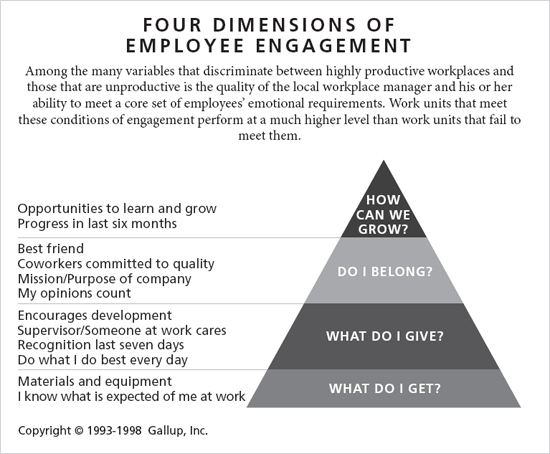
Research shows that most people join organisations, but they leave managers. Managers play the single most important role in ensuring that employees stay involved at the workplace. Whilst financial incentives are critical, working under a right manager can make all the difference in employee engagement and performance improvement. Whilst everyone would like to change the culture of their workplace, the truth is that this change happens in pockets and the major influencer of this change is the manager or supervisor in that area.
Gallup recently published an interesting article on employee engagement which forces one to rethink management principles. In the article employee engagement is referred to as "the ability to capture the heads, hearts, and souls of your employees to instill an intrinsic desire and passion for excellence". Sounds great doesn't it? The engagement model seems quite simple:
- Do you know what is expected of you at work? Do you have the right materials/equipment to do your work right?
- Do you have the opportunity to do your best every day?
- Were your efforts at work recognised or praised in the last 7 days?
- Do your opinions count towards change (small and major) at work?
- Does your supervisor seem to care about you as a person?
- Have you given an opportunity to develop and grow in the last 6 months?
Within the elections environment, with the associated pressures, it can become easy to bully subordinates into following an instruction-based approach, where you "do as you are told and don't ask any questions". There are many experiences that can be recounted where the politics of the situation demands prudence of such a nature that employees should not be allowed to make decisions. This is the view of a manager who wishes to control the entire workplace, who acts out of insecurity rather than out of confidence in the collective value of his/her staff. This manager is focussed more on personal glory than lifting all employees to their best levels. Unfortunately this approach is all too common. Based on bad role models, it is an easy management style to adopt when things get tough. And it is precisely this autocratic management style that will hamper the development of the elections profession and institutions. Valuable experience and competence will be lost to the elections world due to poor managers.
When last did you receive a compliment from your manager or supervisor? Was it in the last 7 days? Did your receive positive feedback on how well you are doing? Have you received constructively feedback on your weak points? We are not talking here of lofty and grand visions and missions. These ideals are important (see my first blog article) to inspire and attract employees. But here we are talking about simple one-to-one engagements where managers can make a real difference. This the the coal-face where performance improvement finds real value.
And if you can achieve this with permanent staff in central and provincial offices, how can this be done with temporary staff working in polling stations? How are they inspired, motivated, engaged to deliver on the ideals of electoral democracies? How do you instill the core values and purpose in a presiding officer or precinct commissioner to do their best in a polling station miles away from your control and scrutiny? I'd like to hear your opinions. Add your comments by clicking the "comments" link below this article (unfortunately) on the website.
Wednesday, November 14, 2007
Capture the learning from older generations
Recently I wrote about baby boomers retiring and attracting new employees to EMBs. There is another dimension to this. How do we capture the relevant learning from older generations? In one EMB that I've worked with, the most experienced election administrator reaches retirement age at the same time as the next major election. What is being done to capture the wealth of knowledge that exists in his mind. Time has shown that his keen electoral instincts have been bred through years of experience and exposure. With the re-appointment of the Chairperson of the Kenyan Electoral Commission recently, there also came a shock announcement that he is retiring after the coming December elections. The same reality confronts many of the senior and executive management and commissioners in these EMBs across the globe. The older generation is retiring with all their knowledge, expertise and experience.
While one should not delay such inevitable change, there is a significant cost of such retirement in the elections context where the timelines are unforgiving and mistakes even less so. In the next six years, people between 41 and 59 will start leaving the elections profession, just they are doing in other industries. Despite the fact that people are now retiring at a later age than 60, the loss in their participation rates and declines in economic efficiency will mean a decrease in value to the organisation. Opportunities will naturally open up to correct areas such as gender and other imbalances in staffing levels. One could also see an increase in outsourcing of certain functions as the expertise around these functions retires and prove difficult to replace. One solution is to simply just employ the younger generation and have them make mistakes and learn. This philosophy has worked over the years, but really doesn't show that we've learnt much except to allow others to fail and repeat out mistakes. In this day and age such an approach needs the support of the older generation to lend a helping hand to decrease the impact of such mistakes. If this older generation doesn't exist, then what happens? Are such mistakes allowable in the elections context?
The use of specialist education and training programmes such as BRIDGE are critical in getting new people up to speed quickly but this also has its limitations without a broader strategic framework around these matters. Executive management in EMBs need to start asking critical and strategic questions of their workforce:
While one should not delay such inevitable change, there is a significant cost of such retirement in the elections context where the timelines are unforgiving and mistakes even less so. In the next six years, people between 41 and 59 will start leaving the elections profession, just they are doing in other industries. Despite the fact that people are now retiring at a later age than 60, the loss in their participation rates and declines in economic efficiency will mean a decrease in value to the organisation. Opportunities will naturally open up to correct areas such as gender and other imbalances in staffing levels. One could also see an increase in outsourcing of certain functions as the expertise around these functions retires and prove difficult to replace. One solution is to simply just employ the younger generation and have them make mistakes and learn. This philosophy has worked over the years, but really doesn't show that we've learnt much except to allow others to fail and repeat out mistakes. In this day and age such an approach needs the support of the older generation to lend a helping hand to decrease the impact of such mistakes. If this older generation doesn't exist, then what happens? Are such mistakes allowable in the elections context?
The use of specialist education and training programmes such as BRIDGE are critical in getting new people up to speed quickly but this also has its limitations without a broader strategic framework around these matters. Executive management in EMBs need to start asking critical and strategic questions of their workforce:
- What are your EMB’s demographics (age, gender, position, years in position and anniversary date)?
- What are your EMB’s retirement policies? Is early retirement encouraged or discouraged?
- What mechanisms and programs must be put in place now to capture key competencies and critical work knowledge of employees who will be retiring?
- Demographic trends show that you may be faced with large groups of both very young workers and very old workers. Will these two groups have different learning needs? Are you prepared to customize your current programs?
- What is the gender breakdown by position? Do specific positions have gender imbalance? Are there programs to correct these imbalances?
- Is your organization positioned to meet the need of the over-60 voter segment? How will this change your organisation? What new skills and competencies will this change require?
Source
Ultimately the question that must be addressed is how does one go about capturing the learning of the older generation in a meaningful way that respects their dignity and at the same time does not patronise the younger generation.
Ultimately the question that must be addressed is how does one go about capturing the learning of the older generation in a meaningful way that respects their dignity and at the same time does not patronise the younger generation.
Tuesday, November 13, 2007
Self-importance in elections
Election management bodies (EMBs) wield a lot of power. As the referee and key player in the elections game, they often call the shots. From deciding the location of voting stations, to staffing and training, to counting procedures and results processing. In most countries they possess a powerful mandate awarded to them by law. Public scrutiny and accountability comes in the form of political party watchdogs, domestic and international observer groups, funding structures such as national treasuries or parliamentary committees and a handful of NGOs that understand the elections machinery.
The legal mandate creates an environment where there is limited competition in the area of elections management. EMBs therefore can choose to improve or not to improve the way they run elections. With public scrutiny only being focussed on the EMB when there is an election, it really becomes easy work between elections. Limited routine scrutiny and no competition can result in an over-inflated sense of self-importance. EMBs can easily slip into a mode of improving their internal workings and cultivating their own internal bureaucracies rather than focussing outward and attending to their major constituents, i.e. voters, potential voters and political parties. With a major dip in funding between elections, internal improvements become easier to tackle. A new bureaucracy is the thing which is chased in the face of less funding, rather than more innovative ways to involve and educate voters or political competitors. One only needs to take a look at the dominant activities within an EMB or the major discussions at management retreats. Is it on strategy or compliance-driven? A quick analysis of such events will indicate whether EMBs are inwardly focussed or outward. Ultimately actions speak louder than words.
The legal mandate creates an environment where there is limited competition in the area of elections management. EMBs therefore can choose to improve or not to improve the way they run elections. With public scrutiny only being focussed on the EMB when there is an election, it really becomes easy work between elections. Limited routine scrutiny and no competition can result in an over-inflated sense of self-importance. EMBs can easily slip into a mode of improving their internal workings and cultivating their own internal bureaucracies rather than focussing outward and attending to their major constituents, i.e. voters, potential voters and political parties. With a major dip in funding between elections, internal improvements become easier to tackle. A new bureaucracy is the thing which is chased in the face of less funding, rather than more innovative ways to involve and educate voters or political competitors. One only needs to take a look at the dominant activities within an EMB or the major discussions at management retreats. Is it on strategy or compliance-driven? A quick analysis of such events will indicate whether EMBs are inwardly focussed or outward. Ultimately actions speak louder than words.
Subscribe to:
Posts (Atom)